on facebook, organizations and movements sometimes create mini-applications to donate your status to their cause. for example, i donated my status to an election day movement that encouraged people to vote. the application automatically updates your status so it appears near the top of your friends' news feeds and attracts their attention. recently, hawkish pro-israel supporters started a "QassamCount" mini-application that updates your status to count the number of qassam rockets sent into israel.
for example, today's qassam count status writes, "QassamCount: At least 16 Hamas rockets hit Israel Saturday. 2 rockets hit houses in the city of Ashkelon."
there is no doubt that hamas rockets sent indiscriminately into israel were wrong and dangerous and should be considered offensive attacks. we must condemn them. hamas says that they want to destroy israel, and we should believe them. violence against israeli civilians is hateful and unjust. the qassamcounts aren't offensive because they are lies. i accept that the qassamcounts are probably true. (that palestinian militants continue to shoot missiles into southern israel, by the way, undermines the central mission of israel's offensive to stop rocket fire into israel proper.)
instead, i think the qassamcounts are offensive because they are so blind and deaf to real reality right now. the israeli response, in ten days of fighting, has killed more than 800 palestinians. an ap report says that just about half of that total has been civilians.
when i was a student at the university of michigan, i participated in a debate between pro-israel and pro-palestinian supporters. no hawkish pro-israel supporter accepted the invitation so a friend of mine asked me to participate. yes, the organization consistently highlighted what they felt were unjust acts committed against palestinians. and yes, the pro-palestinian supporters often undermined or rejected or ignored sensible arguments that highlighted israeli concerns or losses.
i hope that my ideas were thoughtful enough to persuade people that people who support an israeli state are not hateful or unjust. we also hope and pray for peace and justice. yet, i remember this moment, after all, because i remember that several pro-israel supporters strenuously argued that my debate helped legitimize the group's complaints and concerns. they argued that my participation amplified the group's hateful beliefs.
unfortunately, i think the same faulty reasoning lies at the heart of this conflict. there are two whole, parallel narratives that define the israeli-palestinian conflict. it is not my right to judge and dismiss either narrative. i have no power to legitimize or deligitimize someone's beliefs and opinions. in fact, the idea that we should not even talk (TALK!) with someone else because it will legitimize their opinions is so completely offensive and arrogant. in contrast, our democracy is centrally based on the free exchange of free ideas. second, when we boycott dialogue with our enemies, we also boycott the only mechanism that can lead to peaceful progress. we must talk to create peace, and we must create peace.
now. right right now.
the world needs to mobilize an immediate ceasefire and a binding resolution that refers any aggression to an international force. israel has a right to protect her citizens, but she does not have the right to lay waste to palestinian civilians. because the nature of gaza limits any opportunity for a just military action, the only just solution is an international agreement with international support for an international military force to govern the borders.
strong critics contend that israel has committed war crimes. israel has not committed war crimes. there is no holocaust. there is no question, in my opinion, that israel pursues a humane war. they hunt military targets. they try to limit causalities by projecting their advances. they drop leaflets and make radio addresses to warn civilians. they launch sound bombs as early warning signals. they have established a humanitarian corridor to alleviate some suffering. i wholly believe this is true.
however, war is not a perfectly clean operation. in fact, the very nature of war in the densely packed gaza strip insures horrific mistakes. yes, hamas fighters endanger palestinian civilians while they hide inside densely packed civilian areas. yet, we know that even precises strikes will endanger civilians. in fact, israeli strikes have misfired and accidentally killed more than 400 civilians. while i am completely certain israel does not target civilians, they have shown a basic indifference to their clear mistakes. a un school. a complete city block. whole families.
the war in gaza inhumane and unjust. it cannot be otherwise. how do you fight a war against a hateful enemy that will cause you to kill unarmed civilians in a densely packed urban area?
you don't fight it. you organize an international coalition to enforce peace.
i support israel, but i do not support this war. i believe in israel, but i do not believe in this war. i love israel, but i do not love this war.
Showing posts with label social justice. Show all posts
Showing posts with label social justice. Show all posts
Saturday, January 10


Wednesday, January 7
ceasefire.

"The ultimate weakness of violence is that it is a descending spiral, begetting the very thing it seeks to destroy. Instead of diminishing evil, it multiplies it. Through violence you may murder the liar, but you cannot murder the lie, nor establish the truth. Through violence you murder the hater, but you do not murder hate. In fact, violence merely increases hate.... Returning violence for violence multiples violence, adding deeper darkness to a night already devoid of stars. Darkness cannot drive out darkness; only light can do that. Hate cannot drive out hate; only love can do that."
Rev. Dr. Martin Luther King, Jr.
"On Black Power"
1967
Thursday, November 20
detroit
i don't know the whole story, and i'm certain that i don't know all of the information. still, i can't help thinking that there are class issues circling in the ongoing debates on federal relief and bailout programs. it seemed there was a fierce urgency of now to complete the bank bailouts. many people claimed immediate bailouts were necessary to prevent a complete collapse of the worldwide economic system. and the stock market clearly thought that first word of the bailout was positive.
for a long time, i've maintained that free market advocates haven't understood that we already live in a clearly regulated economy. our regulation even predates government stakes in major banks and insurers. we have long lived in a modified free market and modified socialist economy. in many ways, i've felt like our economy mirrors our two party system. we have two stringent poles that advocate for static ideas, even against what real research and real data tells us. (although, i don't know if more economic systems would help our economy in the same way more political parties might help our democracy.)
still, i feel like there is a strong element of class discrimination in the heightened politics of the auto bailout versus the smash mouth agenda of the bank bailouts. while i certainly believe that each bailout should have required tough questions and clear financial plans from congress, why is it that only detroit received an extreme toungue lashing? why, further, does it seem that poor people and lending to poor people served as the right's talking point to explain the mortgage crisis, when in reality, the leadership of banks and need for extreme profits led to greedy and overly risky mortgage driven securities and sub-prime mortgages? why were bankers sitting on one side of the table while auto executives sit on the other?
yes, of course, detroit made serious mistakes in the operation and management of their product lines, including missed opportunities in hybrid and flex-fuel vehicles. and, of course, detroit unions overbargained and failed to realize burdensome corporate debt is also not good for retirement and health care plans. and yes, of course, our government needs to ensure that our money is protected and that there are clear rules for transparency and accountability. yes, we need to reign in executive compensation and make sure that government funds actually work in the way they are intended to help. yes, yes, yes.
but why only for the auto makers? why were the wheels greased for wall street and stopped for woodward avenue? however, why is there such umbrage only at blue collar auto workers? why do white collar workers need to keep their bonuses while blue collar workers need to receive pink slips?
let's regulate. i'm for it. let's help struggling industries. i'm for it. let's have oversight. i'm for it. but, really, why such different perspectives? i think it's class.
for a long time, i've maintained that free market advocates haven't understood that we already live in a clearly regulated economy. our regulation even predates government stakes in major banks and insurers. we have long lived in a modified free market and modified socialist economy. in many ways, i've felt like our economy mirrors our two party system. we have two stringent poles that advocate for static ideas, even against what real research and real data tells us. (although, i don't know if more economic systems would help our economy in the same way more political parties might help our democracy.)
still, i feel like there is a strong element of class discrimination in the heightened politics of the auto bailout versus the smash mouth agenda of the bank bailouts. while i certainly believe that each bailout should have required tough questions and clear financial plans from congress, why is it that only detroit received an extreme toungue lashing? why, further, does it seem that poor people and lending to poor people served as the right's talking point to explain the mortgage crisis, when in reality, the leadership of banks and need for extreme profits led to greedy and overly risky mortgage driven securities and sub-prime mortgages? why were bankers sitting on one side of the table while auto executives sit on the other?
yes, of course, detroit made serious mistakes in the operation and management of their product lines, including missed opportunities in hybrid and flex-fuel vehicles. and, of course, detroit unions overbargained and failed to realize burdensome corporate debt is also not good for retirement and health care plans. and yes, of course, our government needs to ensure that our money is protected and that there are clear rules for transparency and accountability. yes, we need to reign in executive compensation and make sure that government funds actually work in the way they are intended to help. yes, yes, yes.
but why only for the auto makers? why were the wheels greased for wall street and stopped for woodward avenue? however, why is there such umbrage only at blue collar auto workers? why do white collar workers need to keep their bonuses while blue collar workers need to receive pink slips?
let's regulate. i'm for it. let's help struggling industries. i'm for it. let's have oversight. i'm for it. but, really, why such different perspectives? i think it's class.
Sunday, January 14
ourdream

when i was younger, the world seemed so confusing. so many things didn't make any sense. why is there is much poverty? why is there so much injustice?
as i grow, i understand the crazy story more. still, i do not understand the apathy and patience that allows deep and persistent inequality. we retain the institution of slavery in our government, our schools, and our businesses. in an early sermon, dr. king writes, "life is a continual story of shattered dreams.''
the dream remains inspiring. however, we must work to make the dream more real. we should not tolerate the continued injustice and inequality in our communities. as we struggle to promote republican democracy, we must also learn to redress our own tyranny. cain hope fielder explains:
I am sick and tired of hearing Dr. King's 'I Have a Dream' speech when the daily reality is that for an increasing number of Americans, and the African American poor in particular, living is a nightmare.
in august 1967, king explained that he believe equality and social justice remained possible. "i refuse to give up," he said to a panel of journalists on nbc's meet the press. "i refuse to despair in this moment. . . i think in any social revolution, the one thing that keeps it going is hope."
"we have the resources to do it, but we presently don't have the will. negroes and decent, committed whites, maybe they may be in the minority now but they are there, must work together to so arouse the conscience of this issue . . . through direct action."
public comments have increasingly focused on declining standards in the urban black community. however, we still promote an open, free market for business and economy that reproduces inequality. we must support government that supports regulation of industry and trade that promotes equality and social justice. we require a revolution in the way we tolerate systematic poverty and racism. dr. king wrote: ''the law cannot make a man love me -- religion and education must do that -- but it can keep him from lynching me.''
Tuesday, January 9
race blind
conservative and liberal activists have debated the essential merit of diverse, inclusive organizations. policy discussion has increasingly centered on public state universities, including systems in texas, california, and michigan. michigan advocates an explicit formula that considers student race and ethnicity for admission. in bakke v. university of michigan, um argued that diversity best prepares students for success because inclusive classrooms promote open, honest discussions that include diverse experience and perspectives. in contrast, texas and california abandoned affirmative action policies and instated race blind admissions policies. proponents of race blind admissions maintain that students should gain admission based solely on accomplishments, achievement, and merit.
however, recent statistics in texas and california betray conservative policies. there has been a dramatic decline in representation for black and latino students at public universities. timothy egan explains:
the article highlights a central problem with traditional multiculturalism. while conventional diversity programs deride white male privilege, they often reproduce privileged status. black and latino students clearly deserve increased access and support. however, can we privilege only select ethnic and racial groups for support?
i believe the central challenge is class discrimination and class segregation. black and latino families disproportionately earn lower salary and receive less comprehensive education. when we address class, we inherently address injustice from racism. however, we also address every american who is dismissed, ignored, and excluded. that's race blind admissions.
however, recent statistics in texas and california betray conservative policies. there has been a dramatic decline in representation for black and latino students at public universities. timothy egan explains:
In California, the rise of the Asian campus, of the strict meritocracy, has come at the expense of historically underrepresented blacks and Hispanics. This year, in a class of 4,809, there are only 100 black freshmen at the University of California at Los Angeles — the lowest number in 33 years.
At Berkeley, 3.6 percent of freshmen are black, barely half the statewide proportion. (In 1997, just before the full force of Proposition 209 went into effect, the proportion of black freshmen matched the state population, 7 percent.) The percentage of Hispanic freshmen at Berkeley (11 percent) is not even a third of the state proportion (35 percent). White freshmen (29 percent) are also below the state average (44 percent).
the article highlights a central problem with traditional multiculturalism. while conventional diversity programs deride white male privilege, they often reproduce privileged status. black and latino students clearly deserve increased access and support. however, can we privilege only select ethnic and racial groups for support?
i believe the central challenge is class discrimination and class segregation. black and latino families disproportionately earn lower salary and receive less comprehensive education. when we address class, we inherently address injustice from racism. however, we also address every american who is dismissed, ignored, and excluded. that's race blind admissions.
Sunday, January 7
trippin' jan. 7
sunny day
samanth and i recently viewed an inconvenient truth. former vice president al gore presents a blunt review of climate change science and explains the dire consequence of current global warming trends. our building recently started to research installing solar panels on the roof to defray common electricity costs. while first costs are significant, users gain credit for energy sold back to the power grid. over time, users see significant decreases on their energy supply bills. our discussion reflects a growing interest in renewable energy by individual homeowners, small businesses, and larger corporations.
the article explains that rising energy costs led to limited subsidies for solar energy providers and substantial tax credits for consumers. increased demand have also sharpened production cycles and decreased the cost of production, installation, and maintenance. in turn, solar energy is an increasingly valuable investment. the article explains that homeowners can expect to "zero-out" individual electric bills.
clean wages
jared bernstein explains that the new democratic congress will present a minimum wage increase soon. however, president bush and the republican opposition have coupled their support for the bill to further tax cuts. in short, bernstein argues that the bill should be clean of earmarks and party politics. while the minimum wage increase will be dulled by inflation, the proposed tax breaks will remain sharp.
former secretary of labor robert reich also argues for a clean bill. he explains:
speak easy
a recent article profiles the controversy caused by "breaking the silence", a traveling speaking tour that features former IDF soldiers. the soldiers contest "excessive force" and "unethical military behavior" against palestinians in the occupied territories. the speaking tour sparked controversy against the union of progressive zionists, a campus outreach group. the zionist organizations of america (ZOA) demanded their exclusion from the ICC, an umbrella organization for israel advocacy groups.
the soldiers' testimonials are strong and credible. however, they complicate and threaten the traditional narrative presented by israel advocacy groups: israel, the advocacy groups explain, is always correct, always justified, and always humane. political discussion in israel proper is decidedly more complex and more honest.
samanth and i recently viewed an inconvenient truth. former vice president al gore presents a blunt review of climate change science and explains the dire consequence of current global warming trends. our building recently started to research installing solar panels on the roof to defray common electricity costs. while first costs are significant, users gain credit for energy sold back to the power grid. over time, users see significant decreases on their energy supply bills. our discussion reflects a growing interest in renewable energy by individual homeowners, small businesses, and larger corporations.
the article explains that rising energy costs led to limited subsidies for solar energy providers and substantial tax credits for consumers. increased demand have also sharpened production cycles and decreased the cost of production, installation, and maintenance. in turn, solar energy is an increasingly valuable investment. the article explains that homeowners can expect to "zero-out" individual electric bills.
Excess credits are lost at the end of the year, so homeowners, at least for now, cannot make a profit from their solar systems. Even so, the savings can be substantial: in 2005 Mr. Felton paid Pacific Gas and Electric about $2,500 a month for electricity. . . [Today] he seldom sees an electric bill. Borrego Solar estimated the system could save Mr. Felton almost $2 million over 30 years — far more than the $255,000 the system cost him after a $134,000 rebate.
clean wages
jared bernstein explains that the new democratic congress will present a minimum wage increase soon. however, president bush and the republican opposition have coupled their support for the bill to further tax cuts. in short, bernstein argues that the bill should be clean of earmarks and party politics. while the minimum wage increase will be dulled by inflation, the proposed tax breaks will remain sharp.
In 2000, the GOP leadership added these bright ideas to a proposed minimum wage increase: a reduction in the estate tax, increased write-offs for business meals and for business investments, tax breaks for timber companies and for tax-exempt bonds, a higher self-employment health deduction, and expanded enterprise zones. Whatever their merits, neither the legislated tax cuts in 1996 nor the proposed tax cuts in 2000 were "targeted offsets" for businesses paying the minimum wage.
former secretary of labor robert reich also argues for a clean bill. he explains:
In fact, a minimum wage hike may actually help small businesses. Evidence from states that have already increased their own minimum wages suggests that a modest increase convinces more people to enter the labor market -- people like retirees, spouses, or teenagers who wouldn't bother working at a lower minimum wage. With more people willing to work, small businesses have more choice of whom to hire. That means they can find more reliable employees, and reduce costs associated with turnover.
speak easy
a recent article profiles the controversy caused by "breaking the silence", a traveling speaking tour that features former IDF soldiers. the soldiers contest "excessive force" and "unethical military behavior" against palestinians in the occupied territories. the speaking tour sparked controversy against the union of progressive zionists, a campus outreach group. the zionist organizations of america (ZOA) demanded their exclusion from the ICC, an umbrella organization for israel advocacy groups.
the soldiers' testimonials are strong and credible. however, they complicate and threaten the traditional narrative presented by israel advocacy groups: israel, the advocacy groups explain, is always correct, always justified, and always humane. political discussion in israel proper is decidedly more complex and more honest.
"American Zionist organizations. . . are becoming increasingly intolerant and bullying," explains Juan Cole, a professor of Middle Eastern history at the University of Michigan. . . "[T]he UPZ is just being treated as everyone else is that does not toe the ZOA party line, which is: no criticism of Israel is allowed by anyone, ever, and where someone dares engage in it, they should be relentlessly marginalized and punished."
Tuesday, January 17
our dreams
the rev. dr. martin luther king, jr. passionately believed in america. he believed that america was filled with grace and beauty and hope. however, dr. king also passionately argued that america failed american blacks. he argued that america had failed its sacred obligation to protect all of its children.
today, we must remember his dream. however, we also must remember that dr. king's dream was a sharp and serious rebuke to violent, systemic inequality. we must remember that king was nonviolent, but he was not passive. he said, "the negro is making it palpably clear that he wants all of his rights, that he wants them here, and that he wants them now."
citizen king, a recent pbs documentary, chronicles the public career of rev. dr. martin luther king, jr. the film specifically focuses on his final years. today, dr. king is most remembered for his early political success, including influence on the civil rights act of 1964 and the voting rights act of 1965. however, we often forget that king forcefully placed civil rights within the context of poverty and social justice.
during the late 1960's, dr. king moved to chicago to spearhead the poor peoples' campaign. the poor peoples' campaign was based on the universal declaration of human rights (1948). for example, dr. king specifically believed that systemic poverty was a gross violation of inalienable rights. in 1968, he declared, " all labor has dignity. . . [we] are reminding the nation that it is a crime for people to live in this rich nation and receive starvation wages."
king was increasingly angry and frustrated. he explained: "it didn't cost the nation one penny to integrate lunch counters. it didn't cost the nation one penny to guarantee the right to vote. but now, we are dealing with issues that cannot be solved without the nation spending billions of dollars and undergoing a radical redistribution of economic power."
while king rallied against inequality, he continued to believe in the "redeeming soul of america." america can be our dreams. we have made important strides in legal integration. however, class continues to segregate education, employment, health care, and housing. for example, surveys consistently report that roughly 25% of children in the united states live in poverty.
i, too, dream of america. but, we are not yet our dreams.
Sunday, December 4
the rev. dr. martin luther king
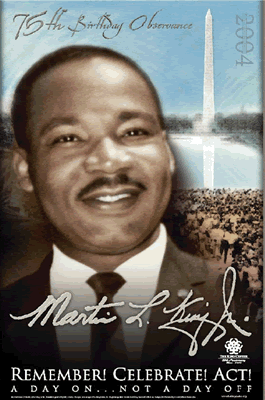
dr. martin luther king, jr. is a modern american hero. he is credited as the spirit and soul of the civil rights movement. dr. king organized large nonviolent resistance for equality, justice, and peace. he is especially noted for his beautiful language – his speeches and writings are direct, honest, hopeful, and sincere.
however, we often remember only his hope. we likely forget his anger, his force, and his honesty. we must remember his beauty. . . yet, today, we cannot forget that he was a stubborn activist against inequality, poverty, and war.
dr. king was trying to wreck! its just his hammers and his bombs were love and peace.
"Freedom is never voluntarily given by the oppressor; it must be demanded by the oppressed."
"The question is not whether we will be extremists, but what kind of extremists we will be."
"The sweltering summer of the Negro's legitimate discontent will not pass until there is an invigorating autumn of freedom and equality."
"Law and order exist for the purpose of establishing justice and when they fail in this purpose they become the dangerously structured dams that block the flow of social progress."
"Without justice, there can be no peace. He who passively accepts evil is as much involved in it as he who helps to perpetrate it."
"Injustice anywhere is a threat to justice everywhere."
Saturday, December 3
union labor
Why are labor unions important?
Strong unions are essential for our continued democracy. In fact, the Steelworkers Union notes that the United States Constitution was ratified in the "gathering hall of the Phildaelphia Guild of Carpenters".
However, labor unions can overbargain. For example, a series of airlines recently declared bankruptcy, including Delta, Northwest, United, and US Airways. Rising fuel costs, increased deregulation, burdensome federal taxes, poor strategic planning, and mismanagement all plagued major American carriers. However, bloated union contracts also prevented airlines from shifting and reorganizing without federal bankruptcy protection.
The real disaster for labor unions is that federal bankruptcy robs skilled and line workers from collective bargaining protections. Strong unions have fought hard to earn important benefits and leading salaries; however, overbargaining harms the long term success or viability of companies. In fact, bankruptcy reorganization plans often strip workers of fair compensation and benefits.
Labor unions are designed to protect work, workers, and workplaces. Effective labor unions are essential to our basic economy, and labor agreements should recognize that effective partnerships benefit both individuals and organizations.
What are you talking about?
There are two major categories of labor unions: craft unions and industrial unions.
Craft unions organize skilled workers, including carpenters, blacksmiths, or painters. Craft guilds organized the first local unions in the late 18th century. Oganized craft unions promotes skilled craftsman and certified craft standards to prevent unskilled craft and unfair wages.
Industrial unions represent workers across individual industries, including steelworkers, shipbuilders, or mineworkers.
Industry unions are vertical: they promote united organization for collective bargaining. A strong union advocates for improved working conditions and worker compensation, including salary and benefits.
Early industrial labor unions were largely unsuccessful. For example, the Pullman Palace Car Company unilaterally reduced wages for line workers in 1894. The American Railway Union (ARU) rejected the forced paycuts and led a dramatic employee strike across 27 states. Eugene Debs, President of ARU, was imprisoned for violation of the Sherman Anti-trust Act. However, the US Supreme Court rejected labor appeals and upheld the policy of the Pullman Car Company.
However, business exaggerated pressure on labor through the early 20th century and radicalized labor unions gained increasing grassroots support. Increased membership led to increased political influence. In 1932, labor unions helped organize important support for the election of Franklin Roosevelt. The Great Depression increased popular commitment and participation in industrial labor unions. This broad support led to dramatic reforms in the supervision and regulation of corporations.
For example, strong labor unions helped promote legislation including the National Labor Relations Act (1935) and the Fair Labor Standards Act (1938). Protective legislation stablished minimum standards for workers' protection, including health and safety of workplace. For example, the NLRA established maximum workweek hours, minimum wage standards, and prohibited child labor.
However, the American labor movement has suffered a significant decline. 1/3 of American workers were enrolled in certified unions in 1960. Yet, recent surveys estimate that labor participation decreased to 13% in 2003.
Who cares?
The Union of Federated Teachers recently completed a contract agreement with the New York City Board of Education. NYC public schoolteachers were working under an expired 2002 contract. The expired contract preserved basic agreeements; however, inflation was rapidly decreasing salary wages.
Today, there is serious disagreement within the Teachers' Union. The offered contract proposes 3% annual wage increases with immediate retroactive pay; however, it also extends the school day and adds additional responsibilities, including cafeteria or homeroom supervision. The UFT President argues that the union has fought for important core values against a stubborn administration. However, many rank and file teachers believe the proposed raise trails inflation and lowballs any increased requirements.
I believe that reforms or requirements that clearly support student learning make real sense. For example, remediation and small group tutoring for struggling students is important and effective. In fact, I currently lead volunteer after-school programs for students. Small group instruction is incredibly rewarding!
However, are we getting fair value?
Strong unions are essential for our continued democracy. In fact, the Steelworkers Union notes that the United States Constitution was ratified in the "gathering hall of the Phildaelphia Guild of Carpenters".
However, labor unions can overbargain. For example, a series of airlines recently declared bankruptcy, including Delta, Northwest, United, and US Airways. Rising fuel costs, increased deregulation, burdensome federal taxes, poor strategic planning, and mismanagement all plagued major American carriers. However, bloated union contracts also prevented airlines from shifting and reorganizing without federal bankruptcy protection.
The real disaster for labor unions is that federal bankruptcy robs skilled and line workers from collective bargaining protections. Strong unions have fought hard to earn important benefits and leading salaries; however, overbargaining harms the long term success or viability of companies. In fact, bankruptcy reorganization plans often strip workers of fair compensation and benefits.
Labor unions are designed to protect work, workers, and workplaces. Effective labor unions are essential to our basic economy, and labor agreements should recognize that effective partnerships benefit both individuals and organizations.
What are you talking about?
There are two major categories of labor unions: craft unions and industrial unions.
Craft unions organize skilled workers, including carpenters, blacksmiths, or painters. Craft guilds organized the first local unions in the late 18th century. Oganized craft unions promotes skilled craftsman and certified craft standards to prevent unskilled craft and unfair wages.
Industrial unions represent workers across individual industries, including steelworkers, shipbuilders, or mineworkers.
Industry unions are vertical: they promote united organization for collective bargaining. A strong union advocates for improved working conditions and worker compensation, including salary and benefits.
Early industrial labor unions were largely unsuccessful. For example, the Pullman Palace Car Company unilaterally reduced wages for line workers in 1894. The American Railway Union (ARU) rejected the forced paycuts and led a dramatic employee strike across 27 states. Eugene Debs, President of ARU, was imprisoned for violation of the Sherman Anti-trust Act. However, the US Supreme Court rejected labor appeals and upheld the policy of the Pullman Car Company.
However, business exaggerated pressure on labor through the early 20th century and radicalized labor unions gained increasing grassroots support. Increased membership led to increased political influence. In 1932, labor unions helped organize important support for the election of Franklin Roosevelt. The Great Depression increased popular commitment and participation in industrial labor unions. This broad support led to dramatic reforms in the supervision and regulation of corporations.
For example, strong labor unions helped promote legislation including the National Labor Relations Act (1935) and the Fair Labor Standards Act (1938). Protective legislation stablished minimum standards for workers' protection, including health and safety of workplace. For example, the NLRA established maximum workweek hours, minimum wage standards, and prohibited child labor.
However, the American labor movement has suffered a significant decline. 1/3 of American workers were enrolled in certified unions in 1960. Yet, recent surveys estimate that labor participation decreased to 13% in 2003.
Who cares?
The Union of Federated Teachers recently completed a contract agreement with the New York City Board of Education. NYC public schoolteachers were working under an expired 2002 contract. The expired contract preserved basic agreeements; however, inflation was rapidly decreasing salary wages.
Today, there is serious disagreement within the Teachers' Union. The offered contract proposes 3% annual wage increases with immediate retroactive pay; however, it also extends the school day and adds additional responsibilities, including cafeteria or homeroom supervision. The UFT President argues that the union has fought for important core values against a stubborn administration. However, many rank and file teachers believe the proposed raise trails inflation and lowballs any increased requirements.
I believe that reforms or requirements that clearly support student learning make real sense. For example, remediation and small group tutoring for struggling students is important and effective. In fact, I currently lead volunteer after-school programs for students. Small group instruction is incredibly rewarding!
However, are we getting fair value?
Monday, August 22
miseducation
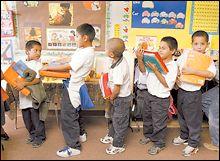
there is an increasing disparity between american communities by class, ethnicity, gender, and region. for example, research illustrates the broad impact of household wealth on child health, nutrition and academic achievement. but, gross inequality is especially evident in public education. in fact, education has the single greatest impact on employment and housing.
recent literature documents the increasing segregation of our public schools by race and class. segregation is especially harmful because it leads to substantial disparities in student achievement. in the shame of the nation, jonathan kozol (2005) maintains that rural, suburban, and urban disparities reproduce apartheid segregation. kozol explains that unequal education forcibly limits access and opportunities for students of color. now that's real. . .
research studies consistently report that students of color have increased rates of school absence, school truancy and school dropout compared to white peers. research also demonstrates that aggregate black and latino youths score dramatically below peers in standardized assessments of math, reading and science.
these disparities have significant consequences. for example, a broad gap in secondary academic achievement leads to even larger deficits in postsecondary enrollment. if high school graduates do not continue to associate or bachelor degree programs, they will earn roughly $30,000 less than college graduates. when we connect poor education to income, health care, and housing, we create and reproduce poverty and segregation.
there is a growing crisis in our schools. it is especially devastating because public education has consistently struggled to provide equal education for diverse students. newspaper headlines dating back to the late 19th century and through the entire 20th century document failing schools.
i'll report further on the history of education and current trends in education reform. what do you think about public education?
Sunday, August 14
inequality

there has been considerable discussion of the afl-cio labor split. in short, the afl-cio was an umbrella agency for several major labor organizations. however, allied unions recently broke away from the afl-cio to reestablish independent unions. now, analysts are trying to figure the political winners and losers.
i am less interested in specific political capital. however, i am very interested in the declining public commitment to organized labor unions. and, i am especially concerned by the increasing inequality in american income and wealth. income and wealth disparity has increased severely since 1975.
inequality is traditionally mesaured by personal income and household wealth. wealth is the calculation of aggregate household assets, including real estate, securities, and savings minus personal debts. household wealth is an especially interesting measure of inequality and social justice because it is especially difficult for lower middle class and lower class families to establish and accumulate wealth.
for example, the top 5% of american households controls more than 60% of total wealth. . . and the top 1% of american households controls more than 40% of total wealth. in fact, the median wealth of the top 1% of american households is $12.5 million. in contrast, the median wealth of the remaining 95% of households is $62,000. this means that the top 5% of american households have more collective wealth than the remaining 95% of households.
this is incredibly severe. however, gross inequality is only one major part of a major problem. concentrated inequality is my second major concern. concentrated inequality means that poverty is disproportionately concentrated in specific communities or groups. for example, blacks have only 18% of the wealth of the average white family. in fact, 45% of black households earn less than $10,000 in personal income! and further, the median household wealth for latino families is $11,450 and $15,000 for black families. (cfa, 2002). this is more than $70,000 below the wealth of the median american household! (cfa, 2003)
there are many reasons why the income and wealth gap continues to increase. in fact, the wealth gap increased 21% between 1998 and 2001. first, our tax system is increasingly regressive. in 1980, the federal government assessed taxes at 70% of personal income. however, today, the top tax bracket pays only 37%. congressional reports demonstrate that the middle class and lower class pays an increased share of federal tax receipts. does that make any sense?
further, corporations increasingly receive tax benefits and tax relief that protect inflated profits. for example, tax reforms allow american corporations to effectively pay $11 billion less annually than required by specific state and federal tax law. major multinational corporations have also fostered an increasing disparity between executive salaries and line wages. in fact, the income gap has nearly doubled since 1978. . . and the increasing disparity is traced by a declining commitment to organized union labor.
inherited wealth and inherited poverty remain the greatest single determinant for social mobility. fifteen years ago, william julius wilson identified "the truly disadvantaged", a permanent underclass in urban american communities. he determined that contemporary economic policies and unregulated market forces created a sustained cycle of intense poverty.
unbelievably, it's getting worse. gross inequality continues to threaten our economic stability and a sustainable american democracy. capitalism encourages innovation. it encourages individuals and corporations to create, develop, and produce effective products and services that a consumer public demands. however, unregulated capitalism does not work. it exaggerates household wealth and poverty, and it severely limits opportunity and social mobility. it's not only unfair . . . it's poor economic policy.
Subscribe to:
Posts (Atom)