in social work, i studied young adolescent identity development. i was deeply interested in how young adults tested and confirmed their personal and social identities. in order establish a clear definition of identity for reserach, it's necessary to define identity and the variables that define identity exploration and identity confirmation.
i remember that one very important variable in my research, self-efficacy, measured an individual's belief that they would succeed or fail in relation to real personal experience. for example, high self efficacy means that an individual has a strong belief that he or she will succeed, even though objective personal experience may not show that to be true. in contrast, low self efficacy means that an individual believes that he or she will fail, even though all personal experience should lead the individual to believe that they will be successful.
i am thinking about that know because it's always really stuck with me. i've felt, when i've looked at myself, that i succeed. i know that if i set out to achieve a goal, i will achieve that goal. i've really deeply beleived that, and of course, there are a series of goals that i have been fortunate to accomplish. at the same time, i realize also, that by choosing to beleive that i am a string of successes, i have chosen to deemphasize or outright ignore significant experiences where i have failed or simply not achieved my goal.
it's interesting, though, because i see that as you believe, as you genuinely believe that you can accomplish hard tasks, you are first increasingly likely to take them on and second increasingly likely to succeed at them. you unconsciously marginalize marginal setbacks and emphasize personal accomplishments as representative.
it reminds me of when somebody says to a young teacher, "fake it til you make it." i don't really believe it's like that because i don't think you set out to marginalize or emphasize this accomplishment or that failure. i think, inside of the matirx of variables of identity, when you come to clearly confirm a personal identity, it is because you have a deep seated understanding of who you are and who you truly want to be.
unless of course, it isn't true at all. unless, of course, this whole thing is a sham and i'm right back where i was when i was 16. who am i? who am i now? who was i then? who do i want to be? how can i be that person i really want to be? and, most importantly, how is it that sometimes, sometimes it feels like i'm so terribly far away?
Showing posts with label identity. Show all posts
Showing posts with label identity. Show all posts
Tuesday, November 25


Friday, August 5
identity: variables
locus of control
self efficacy
self esteem
self concept
self knowledge
(self reflection and insight)
identity status (exploration and achievement)
self efficacy
self esteem
self concept
self knowledge
(self reflection and insight)
identity status (exploration and achievement)
Tuesday, July 26
msw portfolio: ethnic identity
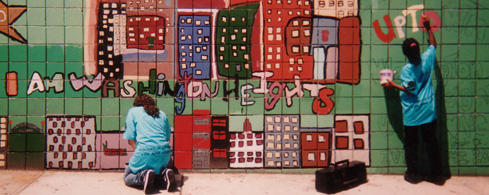
in 1997, during the summer, i lived uptown in washington heights. i worked for fresh youth initiatives, or fyi, a progressive social service agency for community youths. that summer, i completed my first service with young people. together, we learned all about different kinds of art, and the youths drew and painted original artwork for a community calendar. near the end of the summer, we also designed and completed a large mural on the east wall of a major store at 171st and broadway. in the middle of the long wall, the youths painted: "who am i?" below, they drew neighborhood landmarks and highlighted scenes from their lives. they said: "i am washington heights." "i am somebody." "i am america."
i've been especially interested in identity since i was a young adult. i can remember wondering: "is this me?" "is this how i sound?" "is this what i'd say?" as an adult, i am still very invested in identity. i deeply believe that identity, identity achievement, and identity exploration, are essential for positive personal development. in fact, i focused my social work research and study on identity and youth development. my research is specifically interested in the relationship between ethnic identity and prosocial youth development. (warning: geeky stuff below)
identity theory and research is largely directed by the early research of erik erikson. erikson proposed that individuals confront specific psychological challenges at identified developmental stages. for example, major stages of development include the individual achievement of trust, autonomy, identity, and intimacy. however, the negative resolution of development stages includes mistrust, isolation, identity confusion, and despair.
erikson determined that the primary crisis in adolescent development is the exploration and achievement of a stable ego identity. erikson explained that identity is the synthesis of individual beliefs, behaviors, and experiences. in his continued research, erikson identified two primary dimensions of identity: personal identity and social identity. our personal identity constructs a private self, including our core attitudes, behaviors, and values. in contrast, the public self demonstrates our external orientation, including an active personality or social type in the context of other individuals or groups.
subsequent research demonstrates that identity exploration and identity achievement is especially important for individuals of racial or religious ethnicity. scholars followed the basic structure of psychosocial identity developed by erikson. however, they further detailed specific components of personal and social identity. for example, significant research explores ethnic identity. ethnic identity includes the individual affirmation of beliefs, behaviors, traditions, and values from a shared culture, race or religion.
in my research, i specifically review ethnic jewish identity. jewish identity has been extensively researched by community leaders, psychologists and social scientists. however, there is considerable disagreement on the specific variables used to measure jewish identity. i contend that jewish identity must be measured within the established research and theory on psychosocial identity, including ethnic identity.
in short, ethnic jewish identity does not privilege any specific belief, behavior, or tradition. in contrast, it measures the collective elements of jewish belief and behavior, including community, culture, and religion. this definition recognizes that individuals define and connect to judaism and jewish culture in very diverse ways. we can measure the relative strength and resiliency of individual ethnic jewish identity. however, we cannot marginalize specific belief or practice.
if you'd like to learn more about my specific research, follow the links below.
to view a summary of my research project, please read the "survey of ethnic jewish identity: the jewish academy of metropolitan detroit" (2004)
to learn more about the specific construct of ethnic jewish identity, please view the survey administered to students.
Part I: Student Demographics
Part II: Multigroup Ethnic Identity Survey
Part III: Ethnic Jewish Identity
Thursday, July 14
ma thesis: jewish identity
jewish identity is a central topic in the professional jewish community, today. for example, research determines that connected jewish identity promotes sustainable affiliation, community participation, continuous jewish learning, and engaged jewish philanthropy.
however, identity was also extremely important during late antiquity. oppressed communities were denied full participation in imperial society. for example, subordinate groups were required to pay additional land, poll, or population taxes. in contrast, privileged communities were often exempt from special taxes and allowed the autonomy to administer local government.
this summer, i am working to complete my thesis in judaic studies: "what is jewish? jewish identity during the late second temple period". i will evaluate scholarship on judaism during late antiquity, and i will specifically focus on the development of guidelines and practice for conversion.
in the beginnings of jewishness (1999), shaye cohen evaluates the complex identity of jewish communities in late antiquity. he asks, "what is it that makes us us and them them?" in short, cohen concludes that "jewish identity in antiquity was elusive and uncertain."
"who" can be so difficult for scholars because boundaries were so fluid. daniel boyarin (2004) explains that religious authorities constructed increasingly strict private boundaries to limit open, dynamic public boundaries. the historical practice of judaism holds important insights into "what" individual jewish communities considered jewish. for example, can non jewish individuals become jewish?
historical study can also have important implications for our practice. for example, we often assume that orthodox tradition is the direct descendent of historical religion. yet, tradition changes dramatically over time. this does not invalidate any specific observance. neither orthodox judaism or reform judaism are undermined by historical diversity. however, research demonstrates that contemporary cultures have enormous influence on the social development of religion. for example, modern society has profoundly changed the interpretation and practice of judaism. today, there are 3 major streams of judaism: reform, conservative, and orthodox. but, modern judaism can be divided more precisely into humanist, reconstructionist, reform, conservative, traditional, modern orthodox, and orthodox judaisms.
this is not only true in the modern world. internal and external developments also led to substantial diversity during the late second temple period. scholars have identified more than 30 independent jewish groups during late antiquity! gabriele boccaccini (1999) explains that historical judaism is not a singular or "particular ideological system." in contrast, study identifies "many judaisms. . . active and in competition."
however, identity was also extremely important during late antiquity. oppressed communities were denied full participation in imperial society. for example, subordinate groups were required to pay additional land, poll, or population taxes. in contrast, privileged communities were often exempt from special taxes and allowed the autonomy to administer local government.
this summer, i am working to complete my thesis in judaic studies: "what is jewish? jewish identity during the late second temple period". i will evaluate scholarship on judaism during late antiquity, and i will specifically focus on the development of guidelines and practice for conversion.
in the beginnings of jewishness (1999), shaye cohen evaluates the complex identity of jewish communities in late antiquity. he asks, "what is it that makes us us and them them?" in short, cohen concludes that "jewish identity in antiquity was elusive and uncertain."
"who" can be so difficult for scholars because boundaries were so fluid. daniel boyarin (2004) explains that religious authorities constructed increasingly strict private boundaries to limit open, dynamic public boundaries. the historical practice of judaism holds important insights into "what" individual jewish communities considered jewish. for example, can non jewish individuals become jewish?
historical study can also have important implications for our practice. for example, we often assume that orthodox tradition is the direct descendent of historical religion. yet, tradition changes dramatically over time. this does not invalidate any specific observance. neither orthodox judaism or reform judaism are undermined by historical diversity. however, research demonstrates that contemporary cultures have enormous influence on the social development of religion. for example, modern society has profoundly changed the interpretation and practice of judaism. today, there are 3 major streams of judaism: reform, conservative, and orthodox. but, modern judaism can be divided more precisely into humanist, reconstructionist, reform, conservative, traditional, modern orthodox, and orthodox judaisms.
this is not only true in the modern world. internal and external developments also led to substantial diversity during the late second temple period. scholars have identified more than 30 independent jewish groups during late antiquity! gabriele boccaccini (1999) explains that historical judaism is not a singular or "particular ideological system." in contrast, study identifies "many judaisms. . . active and in competition."
Subscribe to:
Posts (Atom)