http://www.huffingtonpost.com/deepak-chopra/intelligent-design-withou_b_6105.html
So, what's up with the new teachers' contract?
Some New York City teachers are disappointed in the recent agreement. Disgruntled teachers maintain that "give-backs" far exceed salary raises.
http://www.library.pitt.edu/labor_legacy/chronology.html
Tuesday, August 23


Monday, August 22
miseducation
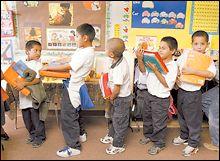
there is an increasing disparity between american communities by class, ethnicity, gender, and region. for example, research illustrates the broad impact of household wealth on child health, nutrition and academic achievement. but, gross inequality is especially evident in public education. in fact, education has the single greatest impact on employment and housing.
recent literature documents the increasing segregation of our public schools by race and class. segregation is especially harmful because it leads to substantial disparities in student achievement. in the shame of the nation, jonathan kozol (2005) maintains that rural, suburban, and urban disparities reproduce apartheid segregation. kozol explains that unequal education forcibly limits access and opportunities for students of color. now that's real. . .
research studies consistently report that students of color have increased rates of school absence, school truancy and school dropout compared to white peers. research also demonstrates that aggregate black and latino youths score dramatically below peers in standardized assessments of math, reading and science.
these disparities have significant consequences. for example, a broad gap in secondary academic achievement leads to even larger deficits in postsecondary enrollment. if high school graduates do not continue to associate or bachelor degree programs, they will earn roughly $30,000 less than college graduates. when we connect poor education to income, health care, and housing, we create and reproduce poverty and segregation.
there is a growing crisis in our schools. it is especially devastating because public education has consistently struggled to provide equal education for diverse students. newspaper headlines dating back to the late 19th century and through the entire 20th century document failing schools.
i'll report further on the history of education and current trends in education reform. what do you think about public education?
Sunday, August 14
inequality

there has been considerable discussion of the afl-cio labor split. in short, the afl-cio was an umbrella agency for several major labor organizations. however, allied unions recently broke away from the afl-cio to reestablish independent unions. now, analysts are trying to figure the political winners and losers.
i am less interested in specific political capital. however, i am very interested in the declining public commitment to organized labor unions. and, i am especially concerned by the increasing inequality in american income and wealth. income and wealth disparity has increased severely since 1975.
inequality is traditionally mesaured by personal income and household wealth. wealth is the calculation of aggregate household assets, including real estate, securities, and savings minus personal debts. household wealth is an especially interesting measure of inequality and social justice because it is especially difficult for lower middle class and lower class families to establish and accumulate wealth.
for example, the top 5% of american households controls more than 60% of total wealth. . . and the top 1% of american households controls more than 40% of total wealth. in fact, the median wealth of the top 1% of american households is $12.5 million. in contrast, the median wealth of the remaining 95% of households is $62,000. this means that the top 5% of american households have more collective wealth than the remaining 95% of households.
this is incredibly severe. however, gross inequality is only one major part of a major problem. concentrated inequality is my second major concern. concentrated inequality means that poverty is disproportionately concentrated in specific communities or groups. for example, blacks have only 18% of the wealth of the average white family. in fact, 45% of black households earn less than $10,000 in personal income! and further, the median household wealth for latino families is $11,450 and $15,000 for black families. (cfa, 2002). this is more than $70,000 below the wealth of the median american household! (cfa, 2003)
there are many reasons why the income and wealth gap continues to increase. in fact, the wealth gap increased 21% between 1998 and 2001. first, our tax system is increasingly regressive. in 1980, the federal government assessed taxes at 70% of personal income. however, today, the top tax bracket pays only 37%. congressional reports demonstrate that the middle class and lower class pays an increased share of federal tax receipts. does that make any sense?
further, corporations increasingly receive tax benefits and tax relief that protect inflated profits. for example, tax reforms allow american corporations to effectively pay $11 billion less annually than required by specific state and federal tax law. major multinational corporations have also fostered an increasing disparity between executive salaries and line wages. in fact, the income gap has nearly doubled since 1978. . . and the increasing disparity is traced by a declining commitment to organized union labor.
inherited wealth and inherited poverty remain the greatest single determinant for social mobility. fifteen years ago, william julius wilson identified "the truly disadvantaged", a permanent underclass in urban american communities. he determined that contemporary economic policies and unregulated market forces created a sustained cycle of intense poverty.
unbelievably, it's getting worse. gross inequality continues to threaten our economic stability and a sustainable american democracy. capitalism encourages innovation. it encourages individuals and corporations to create, develop, and produce effective products and services that a consumer public demands. however, unregulated capitalism does not work. it exaggerates household wealth and poverty, and it severely limits opportunity and social mobility. it's not only unfair . . . it's poor economic policy.
Subscribe to:
Posts (Atom)