1) in the middle, nancie atwell
2) teaching reading in middle school, laura robb
3) wondrous words, katie wood ray
4) how's it going (strategic conferencing), carl anderson
5) the reading zone, nancie atwell
6) strategies the work, stephanie harvey
7) thinking through genre, heather lattimer
8) you gotta be the book! (or strategic reading), jeffrey wilhelm
9) the power of grammar, mary ehrenworth
10) minilessons for literature circles, harvey daniels
Showing posts with label education. Show all posts
Showing posts with label education. Show all posts
Monday, May 31


Wednesday, May 19
workshop method: top ten tips
last year, the new york times reported on a growing movement towards the reading and writing workshop. i thought it was funny at first because we have been teaching workshop for a while now, and so many teachers have started to rebel against workshop because it's now the dominant standard here.
i think the challenge now is that while so many people may have opinions about the workshop method in general, far fewer teachers understand and practice the core principles. i've been working with student teachers the last five years, and these are the top 10 tips and suggestions i give to them.
1) independent reading with a class library.
if you can only choose one thing to start your workshop, so many people agree that you should start with independent reading. traditional instruction focuses on content or new critical readings. however, we know that traditional instruction has failed so many students.
independent reading is based on the belief that students will be more engaged in reading and writing about reading if they are able to choose the books and topics they read and write about. our larger goal is to create lifelong readers who care deeply about the books they read and think about.
this is the single most transformative step for workshop teachers. new instruction focuses on reading skills and strategies, in contrast to specific content or specific readings.
2) architecture of a minilesson.
there are many different ideas and structures that teachers use to develop units and projects and activities. however, if teachers can master the basic workshop minilesson, they can consistently deliver new skills and strategies through effective instruction. this minilesson structure is largely developed and perfected by lucy calkins and the reading and writing project at teachers college.
3) workshop structures: models and mentor texts. write with the students: whatever genre they're writing, you should be writing too.
4) workshop structures: reading and writing rubric. the traits of really good readers and writers. readers: stamina, fluency, volume, comprehension, analysis, commitment. writers: ideas, organization, details, fluency, voice, and conventions.
5) workshop structures: conferences. one on one meetings with students. use them to buoy their work, but mostly to figure out what students need individually or what they all need to help make minilessons.
6) workshop structures: small groups. small minilessons in groups of 4 or 5. you can choose who comes or they can choose. this is something that you're noticing in groups of students but not widespread.
7) remember to always only teach things real readers and real writers really do. don't make up stuff because teachers have to teach. don't use jargon and don't use reading or writing skills or strategies that real people don't use.
8) minilessons work on three levels: big ideas, general skills, and specific strategies. the beginning of the unit should focus on larger ideas. as the unit moves on, narrow your teaching points to general skills and onto specific strategies.
writing:
a) big idea: we write poetry from our heart.
b) general skill: we write poems towards specific ideas.
c) specific strategy: we choose words that help emphasize or highlight the specific ideas.
reading:
a) big idea: readers use strategies to help understand our reading. connect, infer, question, visualize, predict, analyze, retell.
b) general skill: readers predict to help follow the story sequence.
c) specific strategy:readers make effective predictions by using specific information they already know: from the genre, from other stories, from this story
9) try out independent writing
10) portfolio assessment
11) plus: read professional books to update your practice!
i think the challenge now is that while so many people may have opinions about the workshop method in general, far fewer teachers understand and practice the core principles. i've been working with student teachers the last five years, and these are the top 10 tips and suggestions i give to them.
1) independent reading with a class library.
if you can only choose one thing to start your workshop, so many people agree that you should start with independent reading. traditional instruction focuses on content or new critical readings. however, we know that traditional instruction has failed so many students.
independent reading is based on the belief that students will be more engaged in reading and writing about reading if they are able to choose the books and topics they read and write about. our larger goal is to create lifelong readers who care deeply about the books they read and think about.
this is the single most transformative step for workshop teachers. new instruction focuses on reading skills and strategies, in contrast to specific content or specific readings.
2) architecture of a minilesson.
there are many different ideas and structures that teachers use to develop units and projects and activities. however, if teachers can master the basic workshop minilesson, they can consistently deliver new skills and strategies through effective instruction. this minilesson structure is largely developed and perfected by lucy calkins and the reading and writing project at teachers college.
- connection
- teaching point
- link
- guided practice (active engagement)
- independent practice
3) workshop structures: models and mentor texts. write with the students: whatever genre they're writing, you should be writing too.
4) workshop structures: reading and writing rubric. the traits of really good readers and writers. readers: stamina, fluency, volume, comprehension, analysis, commitment. writers: ideas, organization, details, fluency, voice, and conventions.
5) workshop structures: conferences. one on one meetings with students. use them to buoy their work, but mostly to figure out what students need individually or what they all need to help make minilessons.
6) workshop structures: small groups. small minilessons in groups of 4 or 5. you can choose who comes or they can choose. this is something that you're noticing in groups of students but not widespread.
7) remember to always only teach things real readers and real writers really do. don't make up stuff because teachers have to teach. don't use jargon and don't use reading or writing skills or strategies that real people don't use.
8) minilessons work on three levels: big ideas, general skills, and specific strategies. the beginning of the unit should focus on larger ideas. as the unit moves on, narrow your teaching points to general skills and onto specific strategies.
writing:
a) big idea: we write poetry from our heart.
b) general skill: we write poems towards specific ideas.
c) specific strategy: we choose words that help emphasize or highlight the specific ideas.
reading:
a) big idea: readers use strategies to help understand our reading. connect, infer, question, visualize, predict, analyze, retell.
b) general skill: readers predict to help follow the story sequence.
c) specific strategy:readers make effective predictions by using specific information they already know: from the genre, from other stories, from this story
9) try out independent writing
10) portfolio assessment
11) plus: read professional books to update your practice!
Thursday, December 25
a poetry stage

today, the new york times introduces elizabeth alexander, a yale professor. president elect obama chose ms. alexander to read a poem at his inauguration. the article reviews past inaugural poems and profiles a few poems from ms. alexander. inside the article, ms. alexander talks about how she is using other poets and other poems to help craft her inaugural poem:
She is going about making a poem for Mr. Obama, she said, by casting an eye back. “I have read the previous inaugural poems, as well as many others,” she said. “The ones that appeal to me have a sense of focus and a kind of gravitas, an ability to appeal to larger issues without getting corny.” One thing Ms. Alexander wants to do, she said, is speak clearly but artfully. “I don’t want the poem to talk down to some imagined audience,” she said. Among the poets she has been reading for guidance are Virgil, W. H. Auden, Ted Hughes, Seamus Heaney and Gwendolyn Brooks.
it's crazy cool to see that she's using other poets to help inform her own poetry. that's something we work on with students. we learn how to be good writers by reading other good writers. it's something we really do, and it's something that real writers really really do! it's important in our workshop that we teach authentic writing. . . that we teach students to write like real writers. that we let them write like they write. they they are able to write the things they want to write in the way they want to write them. we can teach them how to make them better, but one of the most powerful ways to help their writing is to get them reading. reading writers they really like. writers that really know how to write.
Thursday, December 4
independent writing
i've been trying to think a lot about how to make the students' writer's notebooks more effective. . .
Wednesday, November 26
Monday, November 10
independence

(disclaimer: this is way "inside baseball" stuff that may only be remotely interesting, at best, to other teachers.)
i have started taking courses for a new program, and i'm lucky to be taking a course with mary ehrenworth and a course with lucy caulkins. i really decided to start a new program when i took a course last year with sheridan blau. i was thinking about it, and i realized how important it is to challenge and tighten my theory and practice. we talked with sheridan a lot about reader response, but i also remember how sharp he was about really distilling what it is we read, how important it is to be honest and critical and clear about what we thinks and what they think and why.
i just remember thinking a lot about the things that he brought up in class and how it really helped me bring new things in my thinking right into my classroom. i think it really inspired us to start setting our framework for what we're teaching and why we're teaching, and my big thing at the end of last year was to help us set out some clear and consistent goals for our students. in my new class, one of my classmates asked me, "so why are you doing this? is it like some sort of professional development?"
i guess that's exactly what it is. i feel like when we separate our education and our experience that it means we've lost something. i know that sometimes the theory at universities can feel far from my 100 students on the ground, but i also know that they can come up with some of the purest, most important methods in universities away from the pull of department bureaucracy.
this year, my class with lucy is getting me to think about a lot of things in my pattern and philosophy of teaching. in the past, i've worked hard towards developing reading strategies that mirror what real strong readers do when they're reading. and i've worked towards developing writing and revision strategies that mirror what real strong writers do. i think it's so important that we make writing and reading really relevant to how and why we really read. still, it's hard to so closely mirror the independence and choice that are there for real writers in the real world.
so, i've been working through this a lot in lucy's class. the other day she was really strong about getting back to the core principles of writing workshop. it was her george h.w. moment. ("i know writing workshop. i am friends with writing workshop. you, sir, are no writing workshop!) and i know what she means. in some sense, i think, the writing workshop has been so co-opted by being the system, what has become commonplace in workshop is not really workshop at all. and in some other ways i've written in class about how i've been co-opted and inside the system without seeing it. it's hard to see which way is which sometimes.
i've been working a lot with my student teacher to understand exactly what are the principles that support my classroom teaching and learning to make sure that the thigns that we teach are in line with the principles. so, the big thing i'm thinking about is how do we balance independence and choice? and, still, how do we make sure that the students are getting the core skills and competencies that they need? there's no doubt that studetns are more engaged and more invested when they have opportunity and choice. there's also no doubt that they will learn to perform (in the short term) specific skills and strategies when they are taught explicitly and applied directly.
so, what is the balance? where is the balance? i'm thinking the largest balance is by affording choice for projects, and trying to provide consistent small groups that can teach into specific strategies and skills. i feel worried, though, that right now i'm caught right in between both and neither is getting done. i don't wnat to flash on one and feel better. i want to feel like i'm doing better than both, altogether.
Wednesday, December 12
tekmology
recently, i was named to a national commission for reading. it sounds pretty fancy, but i'm sure that we're not super super important. the commission studies recent research on reading and tries to produce advisories and guidelines for field teachers and teaching education programs. the last commission recently received word that a major publisher will publish their recent research for release in early 2008.
at my first meeting, we tried to respond to the keynote speaker's call for applied technology in our classrooms. she explained that our students learn to read and write in diverse media and our teaching and our learning should reflect their new abilities, interests, and needs.
i'm into technology, for sure. (i love my ipod!) i have used a computer since forever, i started my family into blogs, i can still help people with their computer problems, and i even can explain some pretty arcane stuff, sometimes. but, i'm definitely not a full fledged geek. and i tried to be clear to the commission that field teachers don't have any use for technology that doesn't help us get somewhere important. i don't want to bring a computer into my room so i can say we did something on the computer.
that said, i've tried recently to bring in two ideas that i think are really gonna work in the classroom. first, i've worked with a group of class leaders to develop a weblog to begin posting writer's notebook entries. the nice thing about the webiste, though, is that students can bring in all sorts of the media they want to be about and think about and talk about. and, i think it's really important that the students can write and comment and share discussion about the things that they're all thinking about. it gets them to publish in a way. . . to think about what they're writing and to open their ideas and themselves up into a conversation, and i'm excited for it to happen.
also, i started to read the television show "heroes" with my classes. i can be a pretty strict teacher, but i also believe students understand that i like to have fun with them as themselves. i feel like "heroes" allows us to work on the reading skills we've been learning in our books, but it allows them to acquire and practice the strategies on something they find really engaging and interesting.
i'm trying to get the students to understand that we read everywhere: we read books, but we also read people and movies and situations and television shows and settings in our lives. when we ask questions and make predictions and inferences and make connections to help us understand our books, we use the same strategies to analyze and understand our own lives. we don't read to say we read. . . we read because it helps us understand ourselves and our world.
i tell them reading has no meaning to say you have read this book or that. it isn't important to read romeo and juliet to say that you have read shakespeare. it is important, though, to think about and wonder about and know about love and jealousy and honor and loyalty and family. it is important in our lives to know these feeling and these ideas and to make our lives more full and more round. there is meaning in reading, and there is meaning for our reading in our lives. and, i believe, the only reason for students to be interested in reading is because it will deepen and change and enlighten our own ideas about our lives now.
Sunday, December 9
learning hebrew 1 (resources)

when i started graduate social work school at the university of michigan, i applied for a dual degree program in judaic studies. the judaic studies degree required language proficiency in hebrew in order to complete research on primary texts.
while modern hebrew _is_ different than biblical hebrew, i thought that if i learned to be proficient in modern hebrew, i could learn the specific conventions of biblical hebrew alongside my research. in my study, i had to search around a bit to find programs and dictionaries and websites that could help me learn.
i certainly still make a lot of mistakes in my hebrew, but i do feel like all of the things below helped me in different ways. when i first got started, i searched so many websites, but it was difficult to find an easy to understand guide to learning hebrew. if you're interested in finding resources to help learn beginner and intermediate hebrew, i've listed my resources below.
I. online dictionaries
morfix
morfix is the best and most accurate online dictionary for actual words in conversation. it includes nikud (points) for all words, and it suggest all close alternatives if you've misspelled a word. morfix can also reverse a word search, and i often recycle the listed alternatives in hebrew to find a more precise meaning. morfix gives the traditional 3rd person past form as the definition for all verbs. unfortunately, morfix has a tough time with phrase or colloquial searches.
i crosscheck all searches with both lingvosoft and morfix. when i find consensus between the two dictionaries, i can feel confident this is the correct word to use.
lingvosoft
lingvosoft develops and sells language learning and language translation software for more than 30 languages. they also offer a free online dictionary that i use daily. while morfix is the best native dictionary for actual conversation, lingvosoft provides a wider range of words that includes more literary and biblical terms. lingvosoft also provides the full infinitive of each verb, as well as words connected by root or idiom.
babylon
when i need to look up an idiom or colloquial phrase that does not come up in lingvosoft or morfix, i use milon. it has almost always included obscure or challenging phrases the other dictionaries have not. milon is the online dictionary component of babylon software, used in ectaco pocket hebrew translators. however, milon does not use nikudim, which makes pronunciation a bit more difficult for a novice learner.
hebrew-verbs
hebrew-verbs.com is part of an online effort to support hebrew language learning for olim, or new immigrants. on the connected site, you can find structured vocabulary lists, as well as other hebrew language resources. it's very difficult to work through the dictionary, but i do use the verb list as a final resource on the most common verb to use. additionally, the website can list every form and tense for each verb listed. sometimes, i even just use the website as an online flashcard program. it's kind of like an online companion to 501 Hebrew Verbs.
II. language learning programs
ulpan
ulpan is the traditional israeli program to help any level hebrew learner. some students are frustrated because it includes too much conversation, and other students are frustrated because it has too much structure. for me, i thought that ulpan was the only and best way to start language learning, and it was the best way to make sure i kept moving forward in the right way. all of my individual study helped me learn more words, but only ulpan helped me understand how the language worked and how to learn new tenses or noun structures.
every ulpan teacher was always extraordinarily helpful, and i always took at least one major step forward in each level. the one drawback: they're expensive!
ulpan a: summer 2004 (conservative yeshiva - jerusalem)
ulpan a+: summer 2005 (jts - manhattan)
ulpan b: summer 2006 (jcc - manhattan)
ulpan c: fall 2007 (psjc - brooklyn)
pimsleur hebrew I and II
pimsleur and rosetta stone are the two most expensive language programs on the market. it's possible to find pimsleur's torrents online, but i felt badly so i purchased the software from an online store at a discount. i've found that as an intermediate learner i knew almost all of the vocabulary on the sets. however, i've still found the lessons incredibly helpful. the structure or repitition of the lessons really does work, and they gradually stretch you to use new phrases in longer sentences with more difficulty vocabulary over time.
pimsleur uses colloquial pronunciations which you can trust will be understood on the street. the tapes, though, are not designed to give you a comprehensive vocabulary. it is specifically designed to get you up and moving into conversation. it does not cover how or why the language works the way it does.
that said, i think it's the perfect compliment to the other programs i use to learn. it still helps to pracitice listening to the hebrew as well. i absolutely recommend pimsleur, and i'm disappointed to have to wait until at least december '08 for pimsleur hebrew III. (update: version III release date postponed until june.)
rosetta stone
rosetta stone was the first program i bought to help learn hebrew after i completed my first ulpans. it's amazing to help promote vocabulary. you learn to associate new hebrew words with pictures, so you can avoid translating the word back into english to understand. i've found that words learned in rosetta stone that have practical context have stuck really well; where there is little practical context for me to use, i have not kept the words as well.
there is an intense learning curve, though. i don't believe that an absolute beginner user would benefit from buying the program. but, if you have a general understanding of how the language is structured, the system really works. it continues to help me add new words and to help me correct pronunciations or conjugations of existing words. i absolutely strongly recommend the program, although it can get a bit "gamey". resist the urge to play the game to win. i try to guess each panel before they're said, and i also repeat each panel after the speaker announces the statement.
before you know it!
BYKI begins as a free download program to help you build first vocabulary. the deluxe program includes full lists organized by categories, and it also allows you to develop, adapt, or edit your own lists using hebrew letters. BYKI uses a special algorithm to help you learn and memorize new vocabulary words. for example, when you miss a word early on, the program remembers to bring that word back at different intervals to help you acquire its meaning.
i don't think that memorization is the best way to learn a new language, but it absolutely helped me get a memory of new words that i could then try and use. because i speak out loud consistently, i was then able to practice those words and the words made their way into my working vocabulary. as of now, i've worked up to about 400 verbs, 300 adjectives, and more than 500 other words. yay! (update: 700 verbs, 400 adjectives, and more than 1000 other words.) (update 2: they have released a version 4. version 4 allows export to excel and word which helps building words lists for online/iphone flash applications.)
III. online learning programs (text based)
milingua
milingua is a pay site that includes beginner, intermediate, and advanced units. the package also includes verb tables, a hebrew dictionary, and easy short texts. i'm not sure the fee was completely worth it. that said, there's been some really good tips and words and phrases that i've brought into my conversation, and i think they've really helped.
foundation stone
i didn't review the former version of foundation stone because i found it way too confusing and not very helpful. recently, they released a revamped 4.0 version, and it includes much more helpful word lists and super cool audio files for learners. the interface is still a little complicated to use and the word lists are not as expansive as i'd like. however, i believe that you can add to them as you like. more to come here. . .
i recently bought the new iphone, and i have been dying for a native iphone hebrew flashcard application. it's not quite here yet, although byki has released a spanish and french version. (they've limited the add on feature, so it's impossible to use with hebrew.) also, many of the free and open flashcard programs do not support hebrew language. the iphone often reverses the order of the letter and mixes up the nikud.
iflipr does work well. the only problem is that you have to take a few steps to transport the lists you have on your computer to on online database to your iphone. it's great once you get it loaded, though.
1) create list in desktop flashcard program (such as byki)
2) export list to microsoft excel (or other database program: csv or tsv)
3) copy list, create list, or edit list on iflip website
4) click download in iflipr iphone appliction
5) sync decks from your online account to your iphone
IV. online learning programs (audio)
iTunes
there are a good deal of israeli musicians on itunes, now, including classic and traditional artists. a good way to sample a wide variety of music is to test track on user created mixes. there are also two new podcasts listed on itunes to help study and learn hebrew on your digital music players:
both programs are free downloads from the itunes music store, and both programs offer paid subscriptions to additional online content. i believe both websites include additional activities on the core lesson, although i have not used their online lessons. the hebrew podcasts actually started quite recently, so i had moved a good deal ahead of where both lessons begin. at the same time, the podcasts are always getting a bit more advanced and all past lessons are easily retrievable when you subscribe to the programs.
each program starts each lesson with a partner dialogue and then breaks down the dialogue in both hebrew and english afterwards. each program then repeats the complete dialogue again at the end to help reinforce your learning. i feel like learn hebrew now! is a little bit more advanced than hebrewpod. in the end, i found pimsleur much much more helpful for my language learning, and i often found myself hoping that they would just use the pimsleur method. at the same time, pimsleur is also quite a good deal more expensive - these are pretty good options for free!
i purchased vocabulearn as a digital audiobook from itunes. (i linked it, here, to amazon, only because it's easier for me to figure out how to do that.) vocabulearn presents a long series of words to help build et otzar ha-milim (your vocabulary!). the program is a bit awkward because it is really just a long list of words in a line, but it is helpful to discover new words. in addition, it gives both the masculine and the feminine version of adjectives, as well as the verb infinitive. i find the verb infinitive much more useful that the shoresh, or verb root. the language is organized by the verb roots, but it was a bit more complicated for me to figure out the root system until later. vocabulearn was quite cheap, and i still listen to it from time to time to even help review words i know.
IV. learning language texts
ivrit min ha-hatchala
hebrew from scratch is the most used textbook in current ulpan classes for new learners, including new olim to israel. and it is an excellent textbook for guided study in class. lessons include a variety of angles, such as grammar, conversation, and slang around common themes you will need in real life, like food, family, and vacations.
the books are primarily written in hebrew, so it is helpful to immerse yourself in the language. in addition, the series also offers a helpful series of audio cd's to help improve your listening skills. however, i found these books to be really really hard to learn from without a learning group or ulpan class.
ivrit shalav
i started this series on level gimmel, or level 3, so i cannot speak to the first two books. this book is designed specifically for american students. that means, that exercises and activities are most like the way we learned second languages in school. there are dialogues and crosswords and passages. it also means that the directions are largely written in english. i thought this book was awesome to use for self study, picking up and putting down and picking up again a bit later to help practice. there are three books in the full series, as well as a fourth book, a modern hebrew reader, which is great for more advanced but still leveled reading.
501 hebrew verbs
this book is a very popular book for ehinning and intermediate hebrew students. it provides a comprehensive verb table for most common hebrew verbs. this means the book lists past, present, and future tenses for the individual verbs. the book also gives the governing preposition, connected phrases, and sample sentences that show the verbs in context. you can search for words by the english verb or by the hebrew root.
Hebrew Verb Tables
hebrew verb tables has a more comprehensive list of verbs that 501 hebrew verbs; however, verbs are linked to groups or families of verbs with similar patterns. as you become familiar with hebrew, you will start to see that there are patterns and systems that govern grammar and conjugation. it can be helpful to see words in common groups, , but it can also be challenging to figure out the exact conjugation. my general rule is that if a word isn't listed in this book, it probably isn't used colloquially.
easy hebrew newspapers
there are three easy hebrew newspapers with current news and events: sha'ar la-matchil, yanshuf, and bereshit. bereshit is advanced beginner level, yanshuf is intermediate level, and shaar l'matchil is advanced intermediate to beginner advanced level. each newspaper has the option to purchase the newspaper with or without supplemental audio. i felt that the articles and audio were interesting because they identified current events and ideas that made it easy to connect, too. at the same time, i cancelled my subscription to bereshit/yanshuf because it was just too expensive for the content. while it was helpful to read and listen and practice, much of this kind of content can be also found in other books and program for far less money.
there are three easy hebrew newspapers with current news and events: sha'ar la-matchil, yanshuf, and bereshit. bereshit is advanced beginner level, yanshuf is intermediate level, and shaar l'matchil is advanced intermediate to beginner advanced level. each newspaper has the option to purchase the newspaper with or without supplemental audio. i felt that the articles and audio were interesting because they identified current events and ideas that made it easy to connect, too. at the same time, i cancelled my subscription to bereshit/yanshuf because it was just too expensive for the content. while it was helpful to read and listen and practice, much of this kind of content can be also found in other books and program for far less money.
it's important to note that sha'ar recently expanded their options to include a far cheaper digital version of their newspaper. the newspaper includes audio supplements for only $6 per month or $60 for the whole year. this is a much more reasonable and sensible idea. they only allow you to store 4 issues at a time; however, you can also save the papers as a .pdf document forever, and you can record the audio to store on your ipod. i highly recommend this program. the real challenge, though, is that it's quite advanced even for an intermediate learner.
children's books
picture books were incredibly helpful for me. the books tell simple stories that readers can follow in context of illustrations. i was lucky to be able to buy books from an israeli based bookstore here in brooklyn (sifrutake), but you can also find a range of sites online, including steimatsky, orly's, blue white direct, and even צומת, the largest israeli bookstore.
here's a bunch of books aviyah and i loved:
tiras cham
barakevet yoshevet arnevet
ma'aseh b'chamishah balonim
mitz petel
dondon ha-abir
chanan ha-ganan
tuq tuq tuq
ain arayot k'aleh
ata k'var gadol
olivia
sidra dora
sidra kor'im im dora
sidra yuli
sidra or shoelet. . .
to disney children's books. . . (available only in israel, published by ידיעות אחרונות)
to young adult literature. . .
Hugo Cabaret
Diary of a Wimpy Kid
The Alchemist
Twilight
Harry Potter
Eragon
V. online video
heveinu shalom aleichem
the stanford hebrew language webpage hosts a variety of resources, including student produced films. the most valuable link is to "heveinu shalom aleichem", a series of instructional videos to help olim learn modern spoken hebrew. the series is seriously dated, the acting is corny, and the storylines are awful. that said, it was incredibly helpful for me because it helped me practice hebrew listening. i speak hebrew everyday out loud. however, because my daughter is young, i rarely get consistent practice listening to hebrew. so, my spoken hebrew is far more advanced than my listening. "heveinu" helps me adjust to hebrew pace and cadence and helps me practice my accent listening to native israeli speakers.
youtube
youtube has a great selection of hebrew videos, including uploaded rehov sumsum (sesame street) clips and disney videos translated and dubbed into hebrew. my daughter can't get over watching clips from melekh ha-aryot (lion king)! you can also find all major songs from any disney film, including beauty and the beast, the little mermaid, and aladdin. it's been very helpful to search for and print out the lyrics to translate back into english. the words in the disney films can sometimes be literary, but i've definitely learned key words from hakuna matata. in fact, i'm pretty sure that aviyah thinks hakuna matata is a (wonderful) hebrew phrase.
there are also a host of israel television and radio broadcasts you can access online. these are the real deal websites that israelis use to access news stories, music clips, and television clips. caution: they're native speakers speaking hebrew for native speakers so it's fast and complicated. one big help: subtitles on the mabat link!
disney movies
dora the explorer
after i started speaking more fluently, i purchased single dvd's in hebrew. i purchased online steimatskyusa.com and also from tzomet sfarim in israel. there is a large selection of israeli television shows that children love, but it was easier for me to connect with american shows and movies. i have linked to a few clips from the dora television series, and you can also find some nice hebrew dubbed torrents online. if you download a bit torrent application, you can visit any of a series of torrent websites that offer around 7-10 disney and pixar movies. the torrents should be helpful for you to review movies before you decide to purchase them. however, i recommend purchasing the original movies. (the originals include english and hebrew subtitles, which are extremely helpful for me.)

Sunday, March 18
middle school

in january, the new york times introduced an ongoing feature that profiles the challenges for students and teachers in middle school. they report there is specific concern about lagging test scores for 6th through 8th grade students.
Driven by newly documented slumps in learning, by crime rates and by high dropout rates in high school, educators across New York and the nation are struggling to rethink middle school and how best to teach adolescents at a transitional juncture of self-discovery and hormonal change.
the achievement gap is highlighted by recent gains for elementary and high school students. researchers are concerned that tumultuous middle schools may be ineffective, and many recommend the middle years fold into early education primary schools or secondary education high schools.
the times has published 3 reports from a series of 7 articles. the introduction profiles the problem, the second report introduces alternative solutions, and the third report identifies challenges for teachers.
and they've published a interesting multimedia video, as well.
there is a stark contrast between 6th and 8th grade students. 6th grade students are still largely innocent, and they are generally nervous or slow around authority. at times, they make poor choices, and they challenge authority. however, they are still younger and cuter and limited. in contrast, 8th grade students understand they have new voice and new power. they are school seniors, and they walk taller and speak louder than they will in 9th grade.
i am not sure if building space limits reorganization plans, but i feel like k-8 and 6-12 plans still have clear limitations. 6th grade can effectively fold into elementary school. however, 8th grade students are clearly outside primary education. is it possible to shift middle school years to 7th - 9th grade? a recent proposal even recommends that compulsory liberal arts education end after 10th grade. if students are interested in pursuing secondary education, they can attend smaller preparatory high schools for 11th and 12th grade. if students are not interested in liberal arts education, they can choose to attend a professional or vocational high school.
students change so much during middle school. there's an incredibly stark contrast between 6th and 7th grade students. during the beginning of last year, i asked another teacher what she thought happens to students between the two grades. why do they change so much? she said, "puberty." in the end, it may be that middle school buildings are not the largest challenge. it may be biology.
Tuesday, January 9
race blind
conservative and liberal activists have debated the essential merit of diverse, inclusive organizations. policy discussion has increasingly centered on public state universities, including systems in texas, california, and michigan. michigan advocates an explicit formula that considers student race and ethnicity for admission. in bakke v. university of michigan, um argued that diversity best prepares students for success because inclusive classrooms promote open, honest discussions that include diverse experience and perspectives. in contrast, texas and california abandoned affirmative action policies and instated race blind admissions policies. proponents of race blind admissions maintain that students should gain admission based solely on accomplishments, achievement, and merit.
however, recent statistics in texas and california betray conservative policies. there has been a dramatic decline in representation for black and latino students at public universities. timothy egan explains:
the article highlights a central problem with traditional multiculturalism. while conventional diversity programs deride white male privilege, they often reproduce privileged status. black and latino students clearly deserve increased access and support. however, can we privilege only select ethnic and racial groups for support?
i believe the central challenge is class discrimination and class segregation. black and latino families disproportionately earn lower salary and receive less comprehensive education. when we address class, we inherently address injustice from racism. however, we also address every american who is dismissed, ignored, and excluded. that's race blind admissions.
however, recent statistics in texas and california betray conservative policies. there has been a dramatic decline in representation for black and latino students at public universities. timothy egan explains:
In California, the rise of the Asian campus, of the strict meritocracy, has come at the expense of historically underrepresented blacks and Hispanics. This year, in a class of 4,809, there are only 100 black freshmen at the University of California at Los Angeles — the lowest number in 33 years.
At Berkeley, 3.6 percent of freshmen are black, barely half the statewide proportion. (In 1997, just before the full force of Proposition 209 went into effect, the proportion of black freshmen matched the state population, 7 percent.) The percentage of Hispanic freshmen at Berkeley (11 percent) is not even a third of the state proportion (35 percent). White freshmen (29 percent) are also below the state average (44 percent).
the article highlights a central problem with traditional multiculturalism. while conventional diversity programs deride white male privilege, they often reproduce privileged status. black and latino students clearly deserve increased access and support. however, can we privilege only select ethnic and racial groups for support?
i believe the central challenge is class discrimination and class segregation. black and latino families disproportionately earn lower salary and receive less comprehensive education. when we address class, we inherently address injustice from racism. however, we also address every american who is dismissed, ignored, and excluded. that's race blind admissions.
Saturday, December 30
trippin' 2007
the progressive left
a hateful paper published by the american jewish committee claims that progressive liberal politics foments antisemitism.
the paper largely addresses unfortunate increases in public antisemitism. however, it is mistaken and decidedly unfair to claim independent political voices support antisemitism. we must be able to openly and honestly criticize, create, and debate political ideas.
student achievement and poverty
a feature article in the miami herald chronicles the impact of poverty on student achievement and school performance. the article explains that arcane legislation organizes funding for schools and consistently reproduces high density poverty. in short, the article determines:
the article concludes that student achievement is more complex than school funding. however, the associate superintendent contends: ''Money isn't everything. . . but let's get to these children the funds that, by law, they're entitled to.''
2006 color of the year: green
thomas friendman increasingly promotes environmental activism in his columns. in short, he maintains that old business and bush conservatism fund both sides of the war on terror. going green, he explains, is good for the environment and good for business. however, environmental awareness was largely relegated to hippie kooks and hard lefty progressive. now, friedman explains that green is mainstream.
new american jewish population survey
a major 2001 survey estimated there were 5.2 million American Jews. this represented a significant population decline, and it sparked strong concerns in the organized jewish community. however, 2 large surveys recently determined the American Jewish population continues to increase. a survey summary is published in the forward:
a hateful paper published by the american jewish committee claims that progressive liberal politics foments antisemitism.
Jews themselves, especially so-called “progressive” Jews, [contribute] to the intellectual and political climate that helps to foster such hostility, especially in its anti-Zionist forms.
the paper largely addresses unfortunate increases in public antisemitism. however, it is mistaken and decidedly unfair to claim independent political voices support antisemitism. we must be able to openly and honestly criticize, create, and debate political ideas.
student achievement and poverty
a feature article in the miami herald chronicles the impact of poverty on student achievement and school performance. the article explains that arcane legislation organizes funding for schools and consistently reproduces high density poverty. in short, the article determines:
"students who live in poverty go to school less prepared than upper- and middle-class students, score lower on standardized tests and are less likely to graduate from high school."
the article concludes that student achievement is more complex than school funding. however, the associate superintendent contends: ''Money isn't everything. . . but let's get to these children the funds that, by law, they're entitled to.''
2006 color of the year: green
thomas friendman increasingly promotes environmental activism in his columns. in short, he maintains that old business and bush conservatism fund both sides of the war on terror. going green, he explains, is good for the environment and good for business. however, environmental awareness was largely relegated to hippie kooks and hard lefty progressive. now, friedman explains that green is mainstream.
We reached a tipping point this year -- where living, acting, designing, investing and manufacturing green came to be understood by a critical mass of citizens, entrepreneurs and officials as the most patriotic, capitalistic, geopolitical, healthy and competitive thing they could do. Hence my own motto: ''Green is the new red, white and blue.''
new american jewish population survey
a major 2001 survey estimated there were 5.2 million American Jews. this represented a significant population decline, and it sparked strong concerns in the organized jewish community. however, 2 large surveys recently determined the American Jewish population continues to increase. a survey summary is published in the forward:
"Two major new demographic studies estimate the American Jewish population at well above 6 million people, indicating a growing Jewish community that contrasts sharply with popular images of Jewish decline. In particular, scholars say, the new studies appear to refute a widely publicized survey conducted in 2001, which counted 5.2 million American Jews and sparked widespread anxiety over American Jewry’s future."
Thursday, December 28
bonus teachers
several cities have recently introduced merit pay salary programs for public school teachers. merit pay bonuses are generally linked to student achievement on stuandardized tests, and proponents believe that increased pay will increase teacher performance. traditional capitalists maintain that free market choice supports competition and market rate compensation promotes achievement. they further explain that individual workers will work harder to achieve company goals if they receive salary bonuses or increased commissions.
merit pay advocates maintain that "value added assessment" will enhance teacher performance and promote student achievement. in fact, education secretary margaret spelling recently declared:
chicago recently received a $27.5 M federal grant to pilot a merit pay program in 10 volunteer public schools. public school districts are increasingly studying merit pay programs nationwide. legislation or grant programs are in process in california, ohio, texas, massachusetts, michigan, new york, and tennessee. progressive school reforms have dramatically changed our buildings and our classrooms. we must continue to redesign and reshape our schools: urban public schools still have serious challenges.
i sincerely believe cities should use pay incentive to promote effective teaching. however, merit pay bonuses are misguided and ineffective. merit pay is largely centered on student achievement on standardized tests, and standardized tests can be effective measures to study larger trends in education. however, current standardized test programs mandated by NCLB privilege select ideas and skills. students and schools increasingly focus curriculum and resources towards boosting aggregate test scores. yet, research consistently shows that well rounded programs best support long term student achievement.
i believe we should provide pay bonuses to attract teachers to understaffed, underperforming schools. there are too many variables in comprehensive student achievement to accurately assess teacher pay and performance. what is family support? who are cohort teachers? what is adequate classroom progress? is principal discretion too arbitrary? what standards are measured in standardized tests?
chicago mayor richard daley declares that he "wants the very best teachers possible to go to into the most underperforming schools." yet, if we really want the very best teachers possible in the very toughest schools, we need to staff schools with the very best teachers. too often, schools hire from disadvantage. if we create competition for teaching positions in the toughest schools, school administrations can hire from advantage. fixed salary bonuses of $10,000 - $20,000 can increase teacher applications tenfold. ineffective teachers will certainly apply. however, a larger pool of applicants strengthens the very best applications.
capitalist ideals can work in our public schools. choice and competition can provide important platforms to scale student achievement. however, capitalist reforms must be regulated to balance and promote the most effective results. teachers deserve competitive wages. we consistently struggle to design the best lessons that best teach students to be committed, engaged, innovative, and thorough. let's assign salary increases for teachers to staff our most deserving students and schools.
merit pay advocates maintain that "value added assessment" will enhance teacher performance and promote student achievement. in fact, education secretary margaret spelling recently declared:
"[The Teacher Incentive Fund] will reward teachers and principals who show progress in raising achievement levels and closing the achievement gap . . . It works in every other endeavor. Why not [teaching]?"
chicago recently received a $27.5 M federal grant to pilot a merit pay program in 10 volunteer public schools. public school districts are increasingly studying merit pay programs nationwide. legislation or grant programs are in process in california, ohio, texas, massachusetts, michigan, new york, and tennessee. progressive school reforms have dramatically changed our buildings and our classrooms. we must continue to redesign and reshape our schools: urban public schools still have serious challenges.
i sincerely believe cities should use pay incentive to promote effective teaching. however, merit pay bonuses are misguided and ineffective. merit pay is largely centered on student achievement on standardized tests, and standardized tests can be effective measures to study larger trends in education. however, current standardized test programs mandated by NCLB privilege select ideas and skills. students and schools increasingly focus curriculum and resources towards boosting aggregate test scores. yet, research consistently shows that well rounded programs best support long term student achievement.
i believe we should provide pay bonuses to attract teachers to understaffed, underperforming schools. there are too many variables in comprehensive student achievement to accurately assess teacher pay and performance. what is family support? who are cohort teachers? what is adequate classroom progress? is principal discretion too arbitrary? what standards are measured in standardized tests?
chicago mayor richard daley declares that he "wants the very best teachers possible to go to into the most underperforming schools." yet, if we really want the very best teachers possible in the very toughest schools, we need to staff schools with the very best teachers. too often, schools hire from disadvantage. if we create competition for teaching positions in the toughest schools, school administrations can hire from advantage. fixed salary bonuses of $10,000 - $20,000 can increase teacher applications tenfold. ineffective teachers will certainly apply. however, a larger pool of applicants strengthens the very best applications.
capitalist ideals can work in our public schools. choice and competition can provide important platforms to scale student achievement. however, capitalist reforms must be regulated to balance and promote the most effective results. teachers deserve competitive wages. we consistently struggle to design the best lessons that best teach students to be committed, engaged, innovative, and thorough. let's assign salary increases for teachers to staff our most deserving students and schools.
Sunday, May 14
mister, do they smell?

My 7th grade students recently completed Juniors to Seniors, a service/learning project with senior citizens at the Prospect Hill Senior Center in Park Slope, Brooklyn. Prospect Hill provides activities and services for the elderly, including group trips, health services, and Meals on Wheels. Students visited Prospect Hill several times to meet and interview matched seniors to learn about their beliefs and experiences. Following our visits, the students drafted narrative profiles for publication.
Service/learning is an alternative method of education that integrates (old-school) classroom learning and (new-jack) community service. First, teachers and students identify a real community need. Second, we identify supportive community resources and establish a strong partnership with a neighborhood agency. Third, our partnership develops clear objectives, including specific curriculum and program expectations.
Service/learning can be challenging for teachers to integrate into classroom instruction. For example, your school may have a strict, standardized curriculum, and there may be tremendous pressure to lead classrooms through scripted lessons. So, why is service/learning important?
- First, effective service/learning projects help students to learn and retain core academic content. Research demonstrates that creative or experiential education increases student achievement. We may only learn 10% of what we hear; however, we retain up to 80% of what we experience and 90% of what we teach.
- Second, service/learning promotes positive youth development. For example, research explains that participating students demonstrate increased agency, awareness, esteem, and resilience. Participating students are more likely to believe they are able to effect positive change than students who do not participate in service learning programs.
- Third, service/learning is an important tool for classroom and community development. Successful projects promotes student cooperation, partnership, and teamwork. Service/learning also fosters renewable connections between students, communities, and schools. Select research explains that service/learning actively engages students in democracy: students with experience in service/learning are more like to volunteer and to vote.
- Fourth, service/learning can help new teachers to plan teaching and learning over time. Professor Erick Gordon at Teachers College, Columbia University explains that early in his career he invented new tricks to engage students each day. "Lessons worked," he says. "But it was exhausting." Over time, Erick learned that integrated lessons help to streamline planning, manage classroom behavior, and encourage sustained cooperative learning.
Service/learning is an effective and meaningful way to advance student learning: in the classroom and in the community. Juniors to Seniors specifically helped students develop inquiry and narrative writing. Most significantly, the project also helped changed their attitudes about the elderly. "Before I went to the senior center," one student writes, "I wasn’t too happy about the trip because I didn’t think the seniors would like me. But after going to the center, I realized that seniors aren’t what younger people think they are." Another student explains, “My impression of seniors changed. I thought they would be mean, grumpy, and smelly. But, it turns out they are really nice. The visits were fun and I really did enjoy them.”
Friday, March 17
Monday, August 22
miseducation
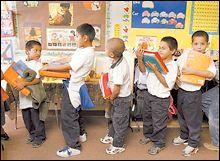
there is an increasing disparity between american communities by class, ethnicity, gender, and region. for example, research illustrates the broad impact of household wealth on child health, nutrition and academic achievement. but, gross inequality is especially evident in public education. in fact, education has the single greatest impact on employment and housing.
recent literature documents the increasing segregation of our public schools by race and class. segregation is especially harmful because it leads to substantial disparities in student achievement. in the shame of the nation, jonathan kozol (2005) maintains that rural, suburban, and urban disparities reproduce apartheid segregation. kozol explains that unequal education forcibly limits access and opportunities for students of color. now that's real. . .
research studies consistently report that students of color have increased rates of school absence, school truancy and school dropout compared to white peers. research also demonstrates that aggregate black and latino youths score dramatically below peers in standardized assessments of math, reading and science.
these disparities have significant consequences. for example, a broad gap in secondary academic achievement leads to even larger deficits in postsecondary enrollment. if high school graduates do not continue to associate or bachelor degree programs, they will earn roughly $30,000 less than college graduates. when we connect poor education to income, health care, and housing, we create and reproduce poverty and segregation.
there is a growing crisis in our schools. it is especially devastating because public education has consistently struggled to provide equal education for diverse students. newspaper headlines dating back to the late 19th century and through the entire 20th century document failing schools.
i'll report further on the history of education and current trends in education reform. what do you think about public education?
Thursday, July 28
teachers college

i recently completed my program in english education. this fall, i will begin teaching 6th grade english at ms 51, william alexander jhs. below, i list the major ideas, methods, and theories that i studied in my education program. i believe that i learned so much in school; however, i also know that i have so much more to learn.
the reading and writing workshop
The workshop method promotes student learning through balanced literacy, or parallel reading and writing instruction. Traditional instruction is wholly directed by teacher lectures and teacher assessment. In contrast, workshop teachers construct a learning workshop for students to acquire, develop, and extend reading and writing skills and strategies. Best practice includes cooperative learning, learning conferences, mini/lesson instruction, strategic reading, and the writing process.
multiple intelligences
Traditional research narrowly defines intelligence as cognitive ability, including logic or reason. However, recent scholarship constructs a more complex definition of intelligence. For example, Howard Gardner contends that individuals have multiple intelligences, including Interpersonal, Intrapersonal, Logical, Musical, Verbal, Visual, Naturalist, Existential, and Kinesthetic or spatial intelligence. Multiple intelligences theory has significant implications for education. For example, research confirms that students acquire and process information in very different ways. Teachers, then, can structure lessons and units to meet the interests and needs of diverse students.
reader response
Historical or biographical criticism tries to determine the authentic intention or meaning of an author. Practical or new criticism develops formal, expert readings of an isolated work, or “the text itself.” In contrast to historical criticism and new criticism, reader response theory contends that texts and interpretations are dynamic. Reader response encourages students to uncover process readings, or the unique associations, ideas, and understandings that readers develop while reading. Reader response theory rejects authoritative or final readings of text. Rather, it contends that reading is a transaction between the culture, environment, and psychology of a reader and a text.
strategic reading
Research demonstrates that strong readers use supportive reading strategies to process and understand texts. Reading strategies are like carpenter tools: we use different reading tools for different reading work. For example, we apply reading strategies to our text in order to clarify content, connect understanding, and analyze or evaluate issues, problems, and meanings. Specific reading strategies include analyze, clarify, infer, evaluate, predict, question, and visualize.
scaffolding
Traditional assessment identifies activities and functions that students can learn or perform independently. However, Lev Vygotsky maintains that assessment should also include a zone of proximal development, or the activities and functions that students can learn with supportive assistance. Scaffolding is the specific assistance or instruction that helps students learn a target concept or skill. Teachers design strong scaffolding for beginning learners. However, scaffolding should slowly recede as students progressively apply skills or strategies without supportive assistance.
literature circles
Literature circles, or book clubs, are student centered groups that read and discuss literature. Circles promote active reading by encouraging students to select and discuss texts that they are genuinely interested in. Students can be accountable for reading through consistent small group discussions, prepared writing responses, and cumulative research project. Literature circles often define temporary task roles for students in group discussions. For example, a student might specifically focus on group questions, connections or images.
genre study
Genre study is the focused study of reading and writing categories, or types. For example, the class will read shared or model texts to help identify the features and purpose of specific genres. Genre study might be organized by culture, history, topic, or style. For example, a short fiction story by Gabriel Garcia Marquez might be classified as short fiction, Latin American fiction, contemporary fiction, or magical realism.
personal learning
Personal learning activities encourage students to connect academic, classroom learning to their personal ideas and experiences. Consistent personal learning activities promote meaningful reflection and foster an inclusive classroom community. Research also demonstrates that personal learning can increase student interest, participation, and achievement.
to be finished:
readers' theater
critical theory
authentic assessment
media literacy
backwards planning: understanding by design
grammar in context
differentiated instruction
constructivism
portfolio assessment
mini/lesson
rubric
the reading workshop
the writing workshop
gifted and talented education
suggested reading
in the middle, by nancie atwell
the literature workshop, by sheridan blau
literature as exploration, by louise rosenblatt
inside out, by dan kirby, dawn lattimer kirby and tom liner
the personal creed project, by john mcrae
teaching grammar in context, by constance weaver
strategic reading, by jeffrey wilhelm
mini-lessons for literature circles, by harvey daniels
Wednesday, July 13
geeky stuff

i have been a student for a minute, now. i really enjoyed studying a lot, and i think that i became a real big nerd. i mean, i think it's more okay to be nerdy as you get older. but, it's crazy because i try to think back about when i officially became a nerd. was i always a big dork and i just didn't realize it? (be nice) i mean, i have a blog now and that's way past nerdy.
: )
i still care alot about creative writing. (my creative writing dream is to be on the charlie rose show. i'll say, "thank you, charlie, for having me." he'll say, "andrew, this is a really striking work. [pause] why did you write _this_ book? what did you _have_ to say?")
but, for now, i think my geeky dream is to write wikipedia entries. (wikipedia is an internet encyclopedia wholly written by the public.) sometimes, i use wikipedia to get a brief introduction for a topic. it helps me start to understand what's going on . . . i think it would be crazy to write one of my own. what would happen if i found one of my own posts?
since i returned to school, i studied a whole bunch of topics in three different subject areas. i found them really interesting, but they're all really different. over time, i think that i'll try to post some of my research, maybe. to start, i've listed some of the topics i studied in social work. so, if you want to hear silly geekspeak . . .
: )
social work:
psychosocial identity
- ethnic identity
- racial identity
- jewish identity
social justice
- privilege and oppression
- human rights theory
- feminism
- empowerment
community organization
- developmental assets
- community strengths
- gis community mapping
- organizational analysis
research studies
- qualitative research
- quantitative research
- survey development
development
- fundraising
- grantwriting
- marketing
- policy analysis
critical theory
- structuralism
- poststructuralism
- postmodernism
Subscribe to:
Posts (Atom)